
Article from Guelph Mercury, November 29, 2014 by Bill Bean
GUELPH — When the German bombers were overhead, the fires were raging and no place seemed safe, weary Britons in the Second World War could count on Guelph and Wellington County for some comfort.
That comfort came in the form of sandwiches, hot drinks and kind words doled out to troops, fire crews and the suddenly homeless by canteen trucks that had been sponsored by Home Front organizations in Canada.
Today, mobile food trucks are an accoutrement of urban life: hot dogs or wrap sandwiches, chipotle or guacamole. And do you want pop or coffee?
When the stretcher bearers were carrying the wounded off the ships that had returned from the evacuation of Dunkirk, or when the fire crews had to take a break after another night of bombing raids by the German Luftwaffe, mobile food trucks were essential.
One history of the Women’s Royal Voluntary Service noted that in the coastal city of Bristol alone, mobile and fixed canteens fed more than 2,000 people a day. The canteens, which were operated separately from the mobile kitchens that provided food to enlisted personnel, were staffed by Red Cross, the Housewives Service, the Women’s Voluntary Service and other volunteer groups.
The mobile canteens were purchased with funds from Commonwealth partners whose civilians were urged to contribute to the war effort.
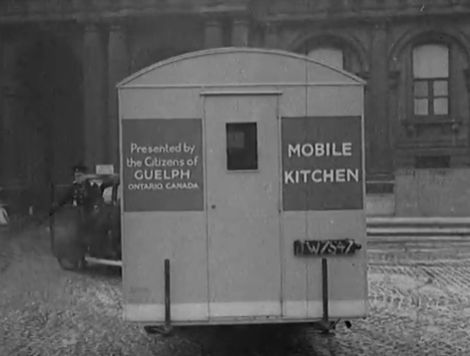
Guelph answered the call for help at least 34 times. One mobile canteen was used in the Blitz, as described by Cyril Demarne in his book “The London Blitz — A Fireman’s Tale.” A surviving mobile kitchen was used by the dock workers at The Historic Dockyard Chatham, on the Medway River near the mouth of the Thames. It is inscribed: “Presented to H.M. Dockyard Chatham for Use By Officers Men & Women of the Yard, by The People of Guelph and Wellington County, Ontario, Canada.”
The actual presentation of a mobile canteen from Guelph, presided over by Canada’s High Commissioner to Great Britain, Vincent Massey, later to become Canada’s governor general, was described by London bureau chief for Southam News A.C. Cummings, for an article that appeared in a 1942 issue of the Hamilton Spectator.
Cummings wrote on May 12, 1942 that “London’s mightiest daily newspapers, its Press Club and its Home Guard composed entirely of newspapermen, figured today in a little Fleet Street ceremony which joined it in thanks to the people of Guelph and Wellington County, Ontario, for the gift of a mobile kitchen, which will be used by Fifth Battalion, City of London Home Guards.”
Cummings wrote that the event was held in Salisbury Square and that, “After inspecting the company of Fleet Street Guardsmen, drawn up on one side of the square, Vincent Massey spoke to the gathering of newspapermen and spectators, telling them funds raised by the Guelph Daily Mirror, their contemporary in a town of 24,000 people, had provided no fewer than 34 mobile kitchens now serving in all parts of the United Kingdom.
“The high commissioner then handed over the mobile kitchen to Colonel the Hon. John Jacob Astor, member of Parliament and chief proprietor of the Times, who received it in his dual capacity as commanding officer of the Home Guard and president of the Press Club. Colonel Astor spoke with greatest admiration of the symbols of affection and comradeship which the Canadian people had so constantly sent to their kinsmen in these islands.
“As for the Home Guard, which he commanded, he could say of them they were trained in the use of both pen and sword and well qualified to wield either.
“Afterwards, the high commissioner and Colonel Astor faced a battery of Fleet Street photographers holding ‘Home Guard sandwiches’ furnished by the mobile kitchen.”
The need of Fleet Street reporters and photographers for a mobile canteen might seem less urgent than that of fire crews or dock workers, a fact reflected in a short editorial page note in the Fergus News Record of June 24, 1943, that suggested “as long ago as October 1941, England had enough or almost enough of these canteens,” and urging Wellington County agencies to consider funding projects other than mobile canteens, such as hospital X-ray equipment.
In fact, food shortages both during the war and for several years after, kept mobile canteens busy, and the post-war political debates over providing food to civilians may have contributed to their disappearance. Few have survived, the Historic Dockyard sample being one of the few extant.
 Vintage Guelph